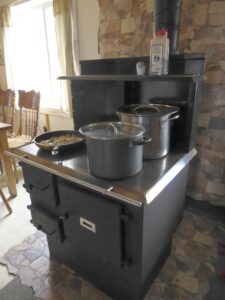
After moving to North Idaho over 20 years ago, not far from the Canadian border, we started noticing a common feature in many of our rural neighbors’ homes: a wood cookstove bearing either the Pioneer Princess or the Baker’s Choice moniker. Both stoves – one larger, one smaller – are made by the same manufacturer, and stand out for their versatility. Not only do they heat the home, but they cook dinner, bake pies, dry clothes (from racks suspended overhead or nearby), and provide a central “point source” of heat for cold fingers on snowy days.

When it came time to replace the antique wood-burning parlor stove that came with our house, we opted to get a Baker’s Choice wood cookstove, the model meant for smaller (2000 square feet or under) homes. It was a game-changer in terms of heating and comfort. Not only did it distribute heat far more efficiently than our old parlor stove, but it lowered our firewood use considerably.
Later, we learned why. Mark Stoll, the Amish manufacturer, designed these stoves from scratch and made numerous groundbreaking improvements over other woodburning stoves, including controlled combustion. These stoves apply the principles of airtight combustion to wood-fired cooking, and represent possibly the biggest advancement in wood cookstoves since the introduction of cast iron.
What these stoves lack in fancy nickel trim and elegant antique design, they make up in efficiency and practicality. In other words, they’re built for function, not form.
One of the biggest complaints about woodstoves is the inability to keep the house warm during long periods without stoking it, such as overnight. This is where the Baker’s Choice shines. With some adjustments to the damper knobs on the side, the air flow can be reduced sufficiently that the logs inside simmer all night long, releasing heat evenly over many hours.
We are currently on our second Baker’s Choice cookstove after regretfully leaving the first one behind when we sold our old house. In transitioning from the older to the newer version of the model, we noted a couple of significant manufacturing improvements. One, the back-wall firebricks in the woodbox are now behind a layer of metal. These bricks were too easy to break whenever anyone slammed logs into the firebox, so having a metal shield was a wise idea.

The second improvement we noted was a part that came with the stove, namely an oval-to-round (seven-inch oval to eight-inch round) stovepipe adapter. It’s an odd size and hard to find. We had to cobble pipes together with our first stove, and it was a hassle. Having this single piece included with the new stove was an enormous help.
Installing the Baker’s Choice (or any wood cookstove) requires following proper installation directions for safety reasons. Once installed, however, the stove becomes a valuable non-electric appliance that insures winter comfort within the home. In our area, it’s not unusual to have multi-day power outages during snowfalls or times of high winds. Because of our Baker’s Choice wood cookstove, we have the ability to heat the house, heat water, cook and bake food, and otherwise be comfortable during times when the electricity is off. In our northern climate, this is an important consideration.

Last Thanksgiving, I challenged myself to cook the entire holiday feast on the cookstove. With the exception of the turkey (which wouldn’t fit in the relatively small oven box), over two days I made two types of stuffing, several pies, dinner rolls, assorted veggies, a casserole, and the gravy, all using the wood cookstove. During winter, I’ll use the round-the-clock gentle heat from the cookstove to cook down pureed tomatoes from our garden into a thick, rich tomato sauce. If I have herbs to dry, I’ll suspend them over the stove. It’s not uncommon for me to set up our clothes-drying racks around the stove to take advantage of the heat.
In short, a wood cookstove in general – and the Baker’s Choice in particular – is an invaluable addition to our household. It’s the ultimate multi-purpose off-grid tool.